


The Making of "Cryptid Hunters"

Our summer reading program takes many months and a whole lot of staff time and creativity to put together. Here's a behind-the-scenes look at how Cryptid Hunters went from an idea to reality.
Creating the Theme

Although we talk about summer reading ideas all year long, Emma and Alaina officially started working on this year's program in January. At their first meeting together, they both prepared a few theme ideas to share with one another and then voted on their favorite theme for this year. Aside from cryptids, potential theme ideas included dinosaurs, Summerween (Halloween in the summer), bugs, underground (about the exciting world beneath our feet), Blackbeard's lost treasure (featuring the Isles of Shoals), and the wild west.

Fun fact: Emma and Alaina first got the idea for a cryptid themed summer reading program in May 2024 when they attended the International Cryptozoology Conference in Portland. At the conference, they learned about Bigfoot sightings in Maine and met Pat Spain, a cryptozoologist, wildlife biologist, author, and host of shows like Travel Channel's Legend Hunter and Beast Hunter for the National Geographic Channel. Did you get a chance to "meet" Pat Spain during our summer reading program? He showed up during our week 2 in-person activity when we were trying to determine if a tooth belonged to the Mongolian Death Worm.
Our Cryptid Hunters planning all started with the idea for the summer reading program teaser trailer. The trailer was brought to life by Jeremy Kasten and BCM and was exactly how Emma and Alaina envisioned it at their first planning meeting in January. Additional teaser trailers centered around "discovering" a field journal in the basement that had belonged to a Berwick cryptozoologist from the late 1800s were loosely planned but never became a reality.
The Field Journal of Elizabeth Fairbanks

Although the teaser trailers featuring the field journal never happened, the journal itself was one of the earliest projects completed for summer reading. The journal of cryptozoologist Elizabeth Fairbanks was created entirely by our Circulation Manager Patrick. Patrick started with an empty journal and a cup of coffee that they used to stain and age the pages. Several knives and an awl were used to add claw marks to the cover, and dirt was rubbed over the journal, as well, to make it looked aged and distressed. Although the story never made it into the journal, Patrick's intention with the destruction of the cover was that Elizabeth had used the journal at one point to protect herself from the claws of an angry cryptid.
There are several Easter eggs hidden throughout the journal. If you flip through the journal at the library, you'll find an ad that Elizabeth submitted to a newspaper looking for an assistant. While investigating the Mongolian Death Worm in Freeport, Maine, Elizabeth suggests to a farmer that he turn his sand-covered field into a tourist attraction, foreshadowing the Desert of Maine. By happy accident, Patrick included mermaids in the entry about the Kraken long before we had decided we were going to include mermaids in our summer reading investigation.
Scroll through the gallery above to see a few of the journal entries.
Unintentionally, raccoons became a running theme throughout the summer reading program. Both Patrick and Emma included them in the projects they were working on, despite creating their projects separately. Raccoons are involved in our escape room puzzle and the final entry in the field journal involves Elizabeth investigating a cryptid sighting in Portsmouth that turns out to be bunch of raccoons. This led to "Azeban", a trickster spirit in Abenaki mythology who is depicted as a raccoon, being an option for patrons to vote on as a name for the Berwick cryptid.
After creating the beautiful journal, we realized that "Elizabeth's" cursive handwriting could be difficult for children to read, so Patrick created a translated version of the journal. If you haven't had an opportunity to see the journal yet, be sure to stop by the library to check it out in person, or you can see the translated version on the summer reading website.
Designing the Logo
In addition to the journal, Patrick also designed this year's summer reading logo. Our original logo idea focused primarily on a flashlight and a light beam, then shifted towards a magnifying glass and footprints. Scroll through the gallery below to see the first round of logo options Patrick created (you might also noticed the start date of summer reading changed along the away!).
The first draft of logo ideas didn't quite capture the theme we were going for, so Patrick redesigned it to incorporate a forest, a magnifying glass, and footprints. Did you spot Bigfoot in the corner, creeping away into the woods?

Although we wanted to keep our featured cryptids for the summer a secret up until we revealed them week by week, we agreed that Bigfoot was such an iconic cryptid that he was safe to include in our promotional materials without spoiling anything we had planned for the summer.
Weekly Stickers
Determining our six featured cryptids for the summer was one of our biggest challenges. We originally planned to include the kraken but ended up switching it out for mermaids once we realized that mermaids were, in fact, cryptids. We also discussed including the Loch Ness Monster but opted to focus on more "local" cryptids and chose Campy, the Lake Champlain cryptid, instead. Other potential cryptids included the Chupacabra, jackalopes, and the Jersey Devil.
Once we settled on our six cryptids, Circulation Specialist Kate started creating the stickers that participants would earn each week for completing activities. A final bonus sticker was also designed for participants who complete all of the summer reading activities and collected all six cryptid stickers.
Click on the gallery below for a behind-the-scenes look from Kate about how she created the stickers.
Kate also partnered with Circulation Specialist Sara to create all of our weekly cryptid themed crafts, as well as the crafts for our Cryptid Camp event.
Designing the Tracker Forms
In addition to her work on the summer reading crafts and Cryptid Camp, Sara designed this year's two tracker forms. The tracker forms were inspired by the idea of camping in the woods on a hunt for a cryptid like Bigfoot.
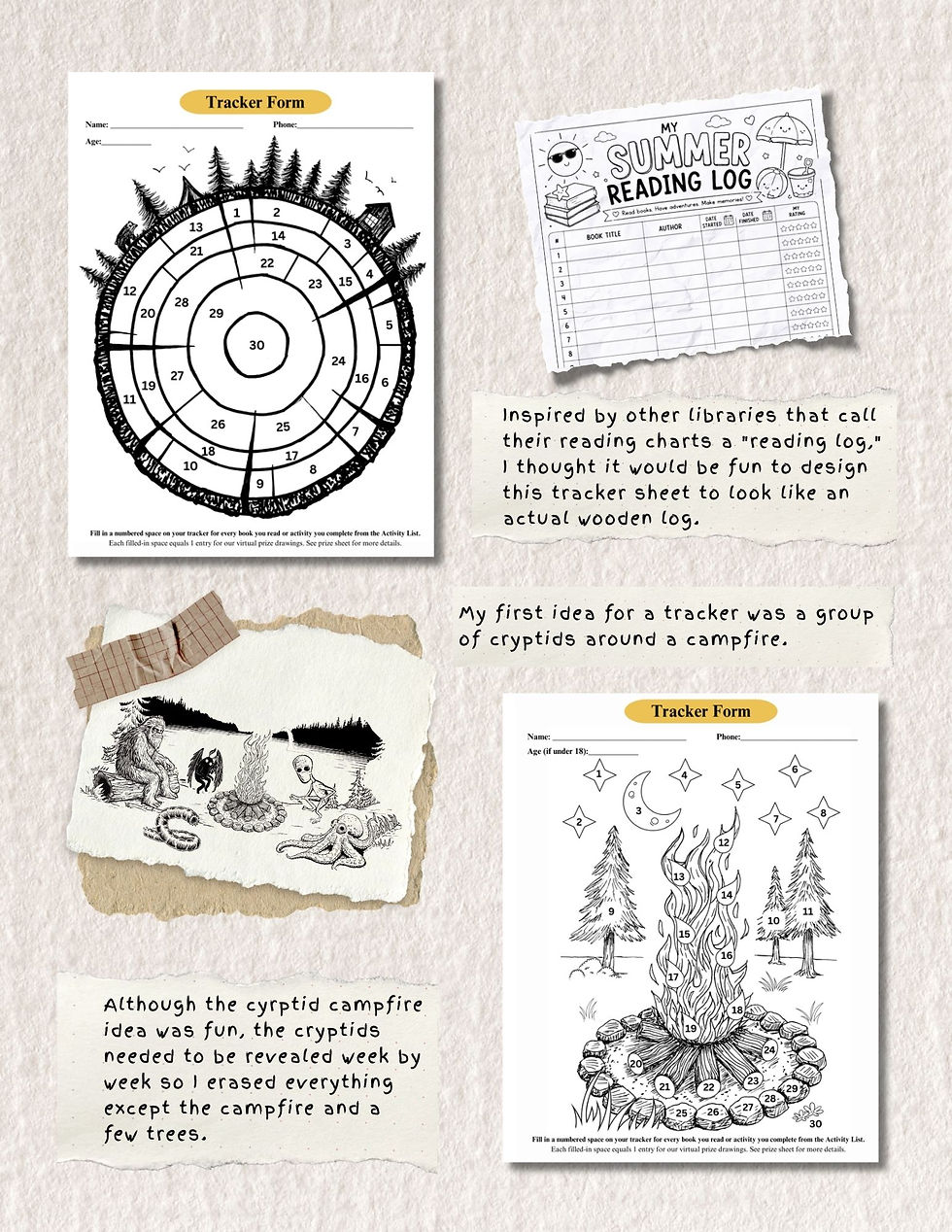
Originally, the log slice tracker form was for teens/adults and the campfire tracker form was for kids. Over the years, we've noticed that teens and adult enjoy coloring in the tracker form a lot more than children do, so we switched them in order to give adults the more detailed tracker sheet.
Puzzles
In order to create this year's puzzles, we worked backwards by first deciding what style of puzzles we wanted to use and then figuring out how to tie those puzzles to each cryptid. For example, we knew early on we wanted to do a puzzle involving collecting items, but we didn't know until a few months into planning that the collecting puzzle was going to involve trading items with a crow in order to examine a potential Mothman feather.
Scroll through gallery below to see a progression of our ideas for the weekly activities.
Emma and Circulation Specialist Sue worked together to design all of this year's puzzles and activities. Early plans for our activities centered around using eye-witness testimony from Emma and Patrick, the staff members who encountered the mysterious creature on the Penny Pond trail in our teaser video, to help analyze the evidence we "collected" from the woods. In the end, we decided to go in a different direction and focus on comparing the evidence to local wildlife and known cryptids that Elizabeth Fairbanks researched.
Ultimately, our goal remained the same no matter what puzzle or activity was being created - we wanted to encourage participants to use their critical thinking skills when analyzing evidence. Does the evidence match a real animal, a known cryptid, or is it something entirely new? We were worried that children might struggle with declaring evidence as belonging to something new, but we saw right away during week one of the summer reading program that it wasn't an issue. Although we created the puzzles with specific answers in mind, we learned early on that each person's analysis of the evidence will be slightly different. While one person may see two fur samples as being identical, someone else may find them to be slightly different - and that's okay!
The Evidence
All of our activities centered around analyzing evidence, but where were we going to get the evidence to analyze? While some of evidence belonged to real animals, other pieces of evidence were made by Alaina. And one piece of evidence was a blend of the two!

For our first week, we analyzed a feather. In the summer reading program storyline, analysis of the feather reveals it does not belong to any local birds or to the cryptid Mothman, but instead belongs to something new and unknown - the Berwick cryptid! In real life, the Berwick cryptid's feather came from Artemis, a green Amazon parrot belonging to Alaina's mother.
During week two of our investigation, we analyzed a tooth to determine if it belonged to a local animal, the Mongolian Death Worm, or a new cryptid. Once again, this piece of evidence was found to belong to a new cryptid. This time around, Alaina made the tooth from scratch. Using a mold (which Sara just happened to find!), the multiple teeth (it's best to have extras!) were created using air dry foam clay. Unfortunately, the mold only makes half a tooth, so two pieces had to be made and stuck together to form a whole tooth. Painting the teeth with a brush created an unwanted crackle effect (as you can see in the middle photo below), so each tooth had to be dipped in white paint multiple times to create a smooth and even coating. A top layer of blue sparkly "galaxy glue" gave the teeth a blue sheen.
Alaina molded the final piece of evidence, a horn piece, out of clay but used a piece of an elk antler dog chew as a base. If you look at the bottom of the finished horn piece, you can still see an exposed part of the elk antler.
Lastly, Alaina also created the evidence board we have on display. This project was ongoing throughout the summer reading program as new evidence pieces were added each week. If you take the time to look at the various pieces on the board, you'll find real news articles alongside pages from Elizabeth's field journal.

Our staff members had a blast creating this year's summer reading program, and we hope you enjoyed playing along! Believe it or not, we're already talking about our plans for next summer. What do you think our next theme will be?


Comments