


Recommendations from the Children's Librarian: Picture Books

Not sure what to read next? Overwhelmed trying to pick something off the shelves at the library? Check out some recommendations from our Children's Librarian, Emma! Don't forget - we're here to help you find the books you want. If you are looking for a book that's similar to something else you've read and enjoyed, trying to find recommendations for a hesitant reader, need help requesting a book from another library, or simply want a book suggestion, let us know!
Wolf in the Snow
by Matthew Cordell (2017)
Bridging together two worlds, Cordell beautifully breaks down the barrier between man and wolf. Told without words, the art tells the rich story of a lost little girl and a lost little wolf cub. Save for a few barks or howls this story is wordless, letting the art speak for itself.

On her way home from school a little girl gets lost in a snowstorm and comes across a little pup just as lost as she is. The child follows the howls of the wolf pack through the forest, the bright red of her coat striking against the trees and snow. All comes to a halt when the pup’s mother finally comes out of the snow, leading to an intense face-off. Unsure of her safety, the little girl stays perfectly still, until the mother and cub walk away. Thinking she’s alone the child curls into a ball, the reader feeling her despair through her terrified eyes. Surprisingly, the wolves come back and begin howling to alert her family, showing their gratitude for the cub’s safe return. This ultimately leads to the girl’s family finding her, and rescuing her from the cold.
The play on Little Red Riding Hood is not missed in this book. This retelling of sorts pushes against the traditional villainization of wolves, and shows them as creatures with families and who are capable of love. The signature red of the girl's coat is always bright and visible within the illustrations. The snow squall in the beginning is artistically done, balancing the numerous white snowflakes with a visible background. The adult wolves are significantly more detailed than the child or the cub, showing their wisdom and importance in the story.
Before the end papers, Wolf in the Snow begins the story. This unusual format thrusts the reader into the world of the little girl, showing her walking to school and introduces the reader to the wolf pack. The acknowledgements and title then separate the story, which is now showing the girl walking home from school. Cordell’s placement of the title and acknowledgements served as a break in the story, allowing for the passage of time in a unique way.
The wordless format of this book helps children use their own imagination to fill in the blanks. They must be the ones to piece together what is happening in the story, leading to increased confidence and independence by reading a story without an adult's help. This book can assist children in developing their skill for looking for context clues through art.

The Stuff of Stars
by Marion Dane Bauer (2018)
A blend of science and art, this book shows the readers the birth of the universe, the planets, Earth, and eventually, the reader themselves! This book connects the reader to the elements that we are made of. Showing the reader that we are made of stardust in such an abstract format opens the conversations to younger children. It also connects the reader to not only their human ancestors, but shows how they are related to other life forms, such as the ravens, the hippopotamus, and the ancient wooly mammoths.
The illustrations were done with hand-marbled paper and collage and assembled digitally. The varying shapes and textures of the collage art showcase the many emotions felt throughout this book. In the beginning, before the universe, before Earth, before hot dogs and picture books, there was nothing. The dark gray colors and the fluid art reflect this. Then all of a sudden, there is a big BANG! Yellows and oranges and blues flood the page, with the marbling forming sharp points and prominent shapes. The formation of the stars is coupled with circular organic shapes, which eventually EXPLODE! These remnants turn into the planets, on which life begins to blossom. There is now the introduction of greens and browns, showing the plant life and the rich soil.
This book is a conversation starter about the Big Bang, what it was, and how we got here - a topic that is groundbreaking to many children. Children are also prompted to think about their connections to their ancestors, and how they got to where they are today. Holmes’s vision of Black imagery and representation fill the reader with a sense of love and community.
Big
by Vashti Harrison (2023)
The reader is introduced to a little girl who has a big heart and big dreams. We see her grow and grow, and see defining characteristics about her fly around the pages in a pink care-free font: caring, considerate, nimble, smart. Until one day, she gets stuck in the swing set at school in front of everyone. Being big is no longer a good thing, and the girl starts to feel unlike herself. She gets bigger and bigger, and grayer and grayer, with her teacher even comparing her to a mountain. We see no support from her friends or family, and eventually the girl learns to process her emotions all on her own. As she lets go of the hurtful comments, she remembers all the good qualities about herself. The gray is slowly replaced by her pink, and the little girl shrinks down to her normal size.
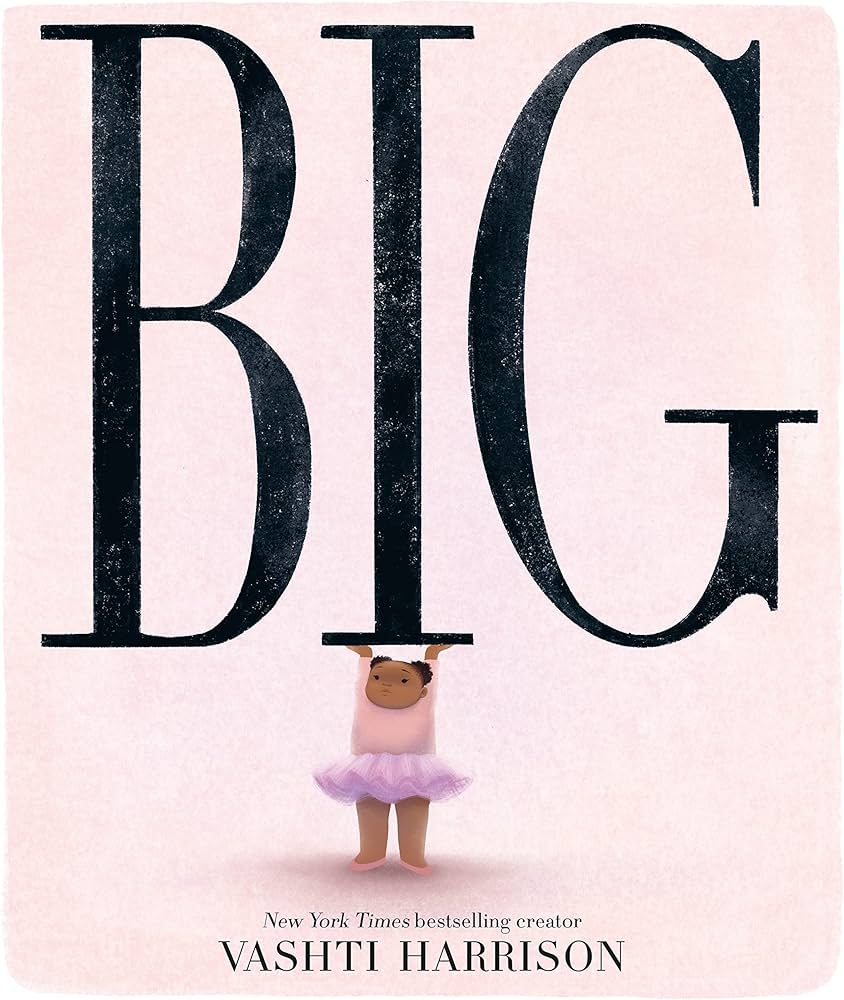
The soft strokes give the story a comforting feel even through the tough sections. Color is a huge factor in this book. When the little girl is hearing comments about her, the negative ones are dark and blue, and the positive ones are light and pink. Her tutu even changes from pink to gray. The girl is also the only character in full color, showing her importance to the story as well as her feelings of isolation.
The size of the little girl is another important factor in this book, showing her growing bigger and bigger until she’s too big to fit onto the page. She falls into a two-page spread, and quickly grows too big for that as well. In a creative use of fold out pages she eventually lets out her emotions, and lets go of the negative comments she’s been told. She decides to make more space for herself, and uses the fold out pages to stretch out her arms, and see a glowing pink reprieve just off page. As she lets go of the negative comments, her gray outfit slowly turns to pink, showing the change in her self-opinion and confidence. The color pink was chosen specifically by the author due to the association with gentle love, tenderness, and nurturing.
This inspiring and highly relatable title can lead to conversations with children about the topics of body image and self-love. Especially for Black girls in big bodies, this book can show children that people come in all sizes and there is nothing wrong with that. The little girl’s ability to process her emotions without outside help gives the reader a stronger connection to the little girl and reassurance that they can do it as well.
The Talk
by Alicia D. Williams (2022)
Meet Jay and his friends: Jamal, Eboni, and Bryant. We see them run up and down the block just like Olympic medalists, and be superheroes helping out with chores. Jay can’t wait to be grown and reach the gas pedal on his family’s car, something many children can relate to. He has a loving supportive family consisting of his Mother, Father, Grandma, and Grandpa. Each spends time with Jay and shows their love for him by taking him to the store, squeezing his cheeks, and even letting him sit in the front seat of the car!
As Jay gets older, his adults start telling him weird ways to behave when in public: no loud talking, no putting his hands in his pockets, no running, and no playing. But Jay asks the question the reader may be thinking: what did he do wrong? The lyrical text is full of fun emotion, making this story a great one to read aloud. The reader can SHHHHHH along with Jay, or howl along with the wind. Awooooo!

The illustrations for this book were rendered digitally. The appearance looks like mixed media, combining gouache, crayon, and pencil. The backgrounds have content showing daily racism and internal biases around the little boy that are noticeable to those who are looking for it. These situations are not acknowledged or noticed by Jay, but are certainly noticed by his adults, prompting the need for The Talk. The main color palette of the story is told in oranges and yellows, showing the boy's love for life and his free spirited attitude.
Once he is told about the reality of being Black in the United States, the pages become dominated by dark blues and blacks, reflecting on the despair Jay feels. The yellows and oranges come back with reassurance and love from his family, showing that life can still be enjoyed by Jay, but with precautions. Oftentimes the two-page spread has art in the middle, but none of the illustrations were lost to the gutters, showing the skill of the designer.
Seeing Jay’s story first hand can lead to increased empathy for readers, many of whom may not be aware of how Black people are treated in the United States. Watching Jay have The Talk with his family without explaining in words what The Talk was about was a creative and unique move. This can lead to readers having conversations with their adults about what Jay’s family told him. This conversation is necessary for Jay’s safety, but for other readers it isn’t necessary for their safety, but is necessary to be able to make a change. Because you can’t change society without knowing that it needs changing.

Separate is never equal: Sylvia Mendez & her family’s fight for desegregation
by Duncan Tonatiuh (2014)
The perspective of Sylvia Mendez herself already leads to children being more connected to her, as she is a fellow child. The readers are introduced to her during her first day of school, where she is being bullied by a white boy for being Mexican. After school, Sylvia cries to her mother about the racist students at her school, where we then learn that the Mendez family recently fought to end segregated schooling in California in 1947. This happened seven years before the supreme court ruling ended segregated schooling across the country. The readers learn of the fierceness of the Mendez family, and how her parents will not accept their children being denied access to the local public school simply because they were visibly Mexican. The determination and support the Mendez’s got from surrounding communities were invaluable in their success. These communities included, but were not limited to, the Japanese American Citizens League and American Jewish Congress, and the reader can hear of Sylvia’s amazement at people from different backgrounds all over the country offering her and her family support, even if they had never met the Mendez’s.
The detail and effort Tonatiuh put into writing this book is unmistakable, incorporating his interviews with Sylvia Mendez as well as information from court files and news accounts. The illustrations for this book were hand-drawn and then collaged and colored digitally. The collage combines a variety of textures with the distinct art style, making an eye-catching picture book. Readers can find just how detailed the textures are, from different hair types and colors, to sandwich bread, to wooden benches and denim jeans.
The end matter consists of an extensive author’s note, a glossary, a bibliography, additional information about the text, and an index. Colorism is shown alongside racism, which can lead to conversations with children about the difference between the two, as well as the similarities. For children to understand that freedom is never a done deal and that increased rights today means increased rights in the future is important. The combination of the unique art style and heavy text results in this book being suitable for older children, as younger readers could get distracted quite quickly.
A Boy and A Jaguar
by Alan Rabinowitz (2014)
This picture book biography shows the life of Alan, a boy with a severe stutter. Despite his struggles to communicate with humans, he finds that he has a gift for communicating with animals instead. The reader sees Alan grow into an adult, as he soars through college and finds himself in the jungles of Belize to study jaguars. He is the first person to do so! Eventually, he overcomes his stutter enough to speak before the prime minister on behalf of the jaguars, leading to the formation of the world’s first and only jaguar preserve. In a heartwarming ending, Alan finds himself face-to-face with a jaguar he was tracking, and thanks the creature for helping him use his voice.

Rabinowitz’s own experience with his stutter allowed him to portray it in an accurate and respectful way. Rabinowitz shows the impact of having an invisible disability, and how not all disabilities are clear to the eye. This book is unique in its way to elegantly illustrate a biography in a picture book format. Although the book is about Rabinowitz’s life, the reader's eyes are drawn to the different creatures he meets throughout.
The end matter contains a short Q and A with the author, allowing the readers to connect with him. The front and back covers open to show a single two-page spread of Alan as a boy and the famous jaguar. Having Rabinowitz be shown as a child on the cover makes this more likely to be picked up by a child to read, rather than a picture of an adult that they don’t know.
Seeing first hand the effects of having a stutter leads children to develop their empathy skills. Readers who have a speech impediment or a disability are given hope and comfort, as this book shows that everyone is capable of making change no matter what others tell you. This feeling of hope can even extend to children who feel like an outsider, or who find comfort in animals over humans.
When Aidan Became a Brother
by Kyle Lukoff (2019)
When Aidan Became a Brother tells the story of Aidan, a boy who everyone thought was a girl. His supportive and loving parents helped Aidan fix the parts of his life that didn’t feel like him, and he became happy with himself. Then one day, Aidan learns he’s going to be a big brother! The readers follow Aidan’s steps at making sure he can be the best big brother he can be, and make sure his little sibling feels heard every step of the way, even if Aidan didn’t get that experience. Aidan’s encouraging mom reassures him that mistakes are normal, and everyone makes them.

The transgender author of the book takes some experiences from his life growing up and chooses to put it into Aidan’s story. This allows for the content to be an accurate portrayal of a young transgender boy, and not just stereotypes held by cisgender people. This book also shows the many ways that babies are gendered. Going against the common two gender mentality, the book changes several common phrases to include all genders. Examples include changing the title of a baby name book from “50,000+ names for boys and girls” to “50,000+ names for babies and babies”. This change is shown by Aidan covering the book with painters tape and writing in the “babies”. The parents also choose to not have a gender reveal party, and instead host a party with a banner that says, “It’s a baby”.
The book is also a way for children to be aware that they have the ability to explore their gender identity. It also builds empathy and compassion towards transgender people: adults and children alike. Lukoff stresses the point that while Aidan is a transgender kid, he’s also just a kid, like the reader! This can bring the reader out of their head and drive home the point that transgender people are people like me or you. The book is also fantastic for any child who is going to be an older sibling. They can relate to Aidan’s nervousness at the changes his family will go through, as well as figuring out how to be a big sibling.


Comments